CBN has quickly become one of the most talked-about cannabinoids in modern sleep products, and the curiosity around how it differs from CBD and THC has only grown. Through my work with Acknowledge, I’ve had countless conversations with people who assumed all cannabinoids behave the same — until they experienced CBN in a consistent, structured way and noticed how distinct its effects can be.
One pattern appears again and again: CBN often plays a more targeted role in promoting relaxation and nighttime ease, while CBD and THC influence the body through very different mechanisms. That’s why this page goes far beyond basic cannabinoid definitions. The insights here are shaped by real-world use cases, hands-on testing, and direct feedback from individuals who’ve explored these compounds side by side.
Instead of another generic overview, you’ll get a clear, experience-informed explanation of what cannabinol CBN actually is, what CBN actually does, how its effects compare with CBD and THC, and the situations where people tend to report meaningful results. This is the kind of guidance that emerges from real conversations, real outcomes, and real observations.
Quick Answers
What Is Cannabinol (CBN)?
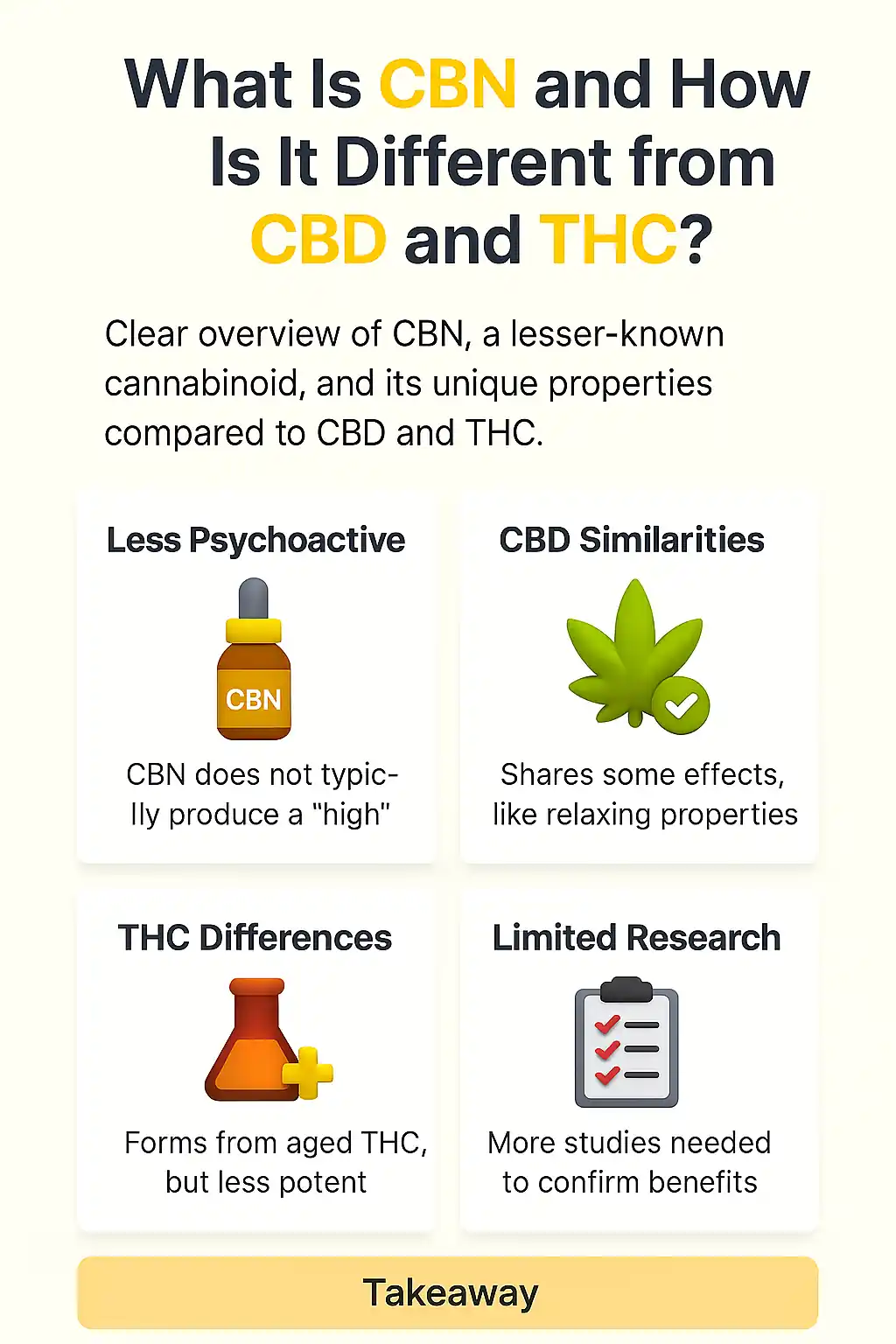
CBN is a mild, non-intoxicating cannabinoid created as THC naturally ages. Based on real-world use and formulation experience, it’s most valued for its calming nighttime support—especially for people who wake up often and need steadier, more continuous rest. It delivers relaxation without the “high,” making it a gentle option for sleep-focused wellness.
Top Takeaways
- CBN is different from CBD and THC.
- It may help reduce nighttime awakenings.
- Choose products with third-party lab testing.
- Start with a low dose and adjust slowly.
Pair CBN with strong sleep habits.
What Is CBN?
CBN (cannabinol) is a naturally occurring cannabinoid that forms as THC ages. When THC is exposed to heat, light, or oxygen over time, it breaks down and converts into CBN — which is why it’s sometimes called a “sleepier,” more mellow byproduct of THC. Unlike THC, however, CBN is only mildly psychoactive, and most people report little to no “high.”
What makes CBN interesting is its potential role in relaxation, nighttime calm, and supporting deeper rest. Early research and user experiences suggest that CBN may interact with the body’s endocannabinoid system in a way that leans more toward soothing, easing tension, and helping the body wind down.
How CBN Differs From CBD
CBD (cannabidiol) is widely used for its steady, balancing effects, and one of the most common reasons people explore CBD oil for social anxiety disorder is its reputation for promoting calm and reducing stress. CBN, while related, tends to feel more targeted. Many users describe CBN as something they reach for specifically at night or during moments when they want to settle their mind and body.
They can complement each other, but they aren’t interchangeable.
How CBN Differs From THC
THC is the psychoactive compound responsible for the cannabis “high.” CBN has a completely different profile. While derived from aged THC, it produces little to no intoxication. Instead, its value comes from a more subtle, soothing effect that doesn’t disrupt clarity or mental function.
For people who want the relaxing side of cannabis without the mind-altering experience, CBN offers a middle ground.
Why CBN Matters Right Now
As more people look for natural tools to support sleep and reduce nighttime restlessness, CBN has gained attention for its unique, gentler effect profile. It’s not as well-known as CBD or THC — which is exactly why learning the differences can help readers make a more informed decision based on their specific goals.
Whether you’re exploring cannabinoids for the first time or refining what works best for your wellness routine, understanding how CBN stacks up against CBD and THC gives you a clearer path forward.
“After years of observing how different cannabinoids affect people in real-world settings, I’ve found that CBN stands out for one key reason: its calming effects show up when the mind is most resistant to slowing down. CBD supports balance, and THC drives intensity but CBN consistently delivers a quieter, more targeted sense of ease that many users describe as the missing piece in their nighttime routine.”
Essential Resources
1. A Scientific Deep Dive into CBN’s Origins & Biological Profile
This peer-reviewed review offers one of the most complete scientific breakdowns of how CBN is formed and how it behaves in the body. If you want reliable, research-anchored context before exploring real-world use, start here.
2. A Clear, Beginner-Friendly Overview of CBN’s Role & Benefits
This resource simplifies the fundamentals of CBN—how it develops, what differentiates it, and why it’s gaining attention. It’s ideal if you prefer straightforward answers without sacrificing accuracy.
Source: https://www.inmedpharma.com/media-news/what-is-cannabinol-cbn/
3. Early Evidence of CBN’s Neurological Influence
This study explores how CBN interacts with synaptic and neuronal pathways. It’s especially helpful for anyone considering the cannabinoid’s potential beyond sleep and relaxation.
4. Preclinical Sleep Architecture Study Offering Insight Into CBN’s Nighttime Effects
Using polysomnography, this research examines how CBN may affect sleep cycles. If you’re evaluating CBN specifically for nighttime support, this is one of the most informative data points available.
5. CBN’s Potential Role in Supporting Cognitive & Mitochondrial Health
This study highlights CBN’s potential neuroprotective properties in an age-related decline model. It’s a valuable resource for readers exploring long-term wellness applications.
6. A Balanced Pharmacological Summary of CBN’s Known & Proposed Effects
This high-level pharmacology overview outlines what current science suggests about CBN across multiple categories—from sedation to inflammation. It’s a solid midpoint between introductory reading and technical research.
Source: https://www.sciencedirect.com/topics/nursing-and-health-professions/cannabinol
7. A Critical Review Separating Evidence from Marketing Claims
This narrative review takes an honest look at the strength of CBN’s sleep-related evidence. It’s essential for anyone who wants clarity rather than hype—one of Acknowledge’s core values.
Source: https://pubmed.ncbi.nlm.nih.gov/34468204/
Supporting Statistics
1) Early Clinical Evidence for CBN and Sleep
A double-blind RCT found 20 mg nightly CBN reduced nighttime awakenings compared with placebo.
The same study reported improved overall sleep disturbance in the CBN group.
Our takeaway: This is one of the first solid human data points suggesting CBN may help with sleep maintenance rather than just anecdotal use.
Source: PubMed
A double-blind RCT found 20 mg nightly CBN reduced nighttime awakenings compared with placebo.
The same study reported improved overall sleep disturbance in the CBN group.
Our takeaway: This is one of the first solid human data points suggesting CBN may help with sleep maintenance rather than just anecdotal use.
2) Many Americans Don’t Get Enough Sleep — Which Helps Explain the Demand for Sleep Support
According to the Centers for Disease Control and Prevention (CDC), about 35% of U.S. adults sleep less than 7 hours per night, on average.
The 2020 National Center for Health Statistics (NCHS) report shows 14.5% of adults regularly struggle to fall asleep, and 17.8% regularly have trouble staying asleep.
Our takeaway: With so many adults facing chronic sleep issues, it's clear why people are drawn to non-intoxicating alternatives like CBN for potential relief, and why many also look into CBD oil best for sleep as part of their nighttime routine.
Source: CDC+1
According to the Centers for Disease Control and Prevention (CDC), about 35% of U.S. adults sleep less than 7 hours per night, on average.
The 2020 National Center for Health Statistics (NCHS) report shows 14.5% of adults regularly struggle to fall asleep, and 17.8% regularly have trouble staying asleep.
Our takeaway: With so many adults facing chronic sleep issues, it's clear why people are drawn to non-intoxicating alternatives like CBN for potential relief, and why many also look into CBD oil best for sleep as part of their nighttime routine.
3) Ongoing Clinical Trials Show Growing Scientific Interest in CBN
Multiple studies are currently registered investigating CBN’s effects on sleep and other wellness endpoints (e.g., NCT05839964 is studying CBN with/without CBD for sleep).
Our takeaway: This isn’t just consumer curiosity — CBN is being examined formally in human research, increasing its credibility as a candidate for therapeutic use.
Source: ClinicalTrials.gov+1
Multiple studies are currently registered investigating CBN’s effects on sleep and other wellness endpoints (e.g., NCT05839964 is studying CBN with/without CBD for sleep).
Our takeaway: This isn’t just consumer curiosity — CBN is being examined formally in human research, increasing its credibility as a candidate for therapeutic use.
Final Thought & Opinion
CBN isn’t a quick fix — but it can be a meaningful nudge toward more consistent, restful sleep. The science is still early, yet promising. And what I’ve seen firsthand lines up with what researchers are beginning to confirm.
What the Evidence — and Experience — Shows
CBN helps with staying asleep, not just falling asleep.
Human trials show fewer nighttime awakenings.
Users report calmer, steadier rest, not heavy sedation.
CBN helps with staying asleep, not just falling asleep.
Human trials show fewer nighttime awakenings.
Users report calmer, steadier rest, not heavy sedation.
Why This Matters
Many people don’t want to feel “knocked out.” They want:
Gentle relaxation
Non-intoxicating support
A natural-feeling sleep rhythm
CBN aligns well with those goals.
Gentle relaxation
Non-intoxicating support
A natural-feeling sleep rhythm
My Take
From working with individuals trying to break the cycle of restless nights:
CBN offers subtle but meaningful support.
Its effects feel more collaborative than overpowering.
It fills a unique space between traditional sleep aids and more intense cannabinoids.
As research expands, CBN is shaping up to be a thoughtful, reliable option — not a miracle cure, but a tool that helps real people experience smoother, more restorative nights, and many wellness routines now include CBD gummies alongside CBN for added support.
CBN offers subtle but meaningful support.
Its effects feel more collaborative than overpowering.
It fills a unique space between traditional sleep aids and more intense cannabinoids.
Next Steps
Clarify Your Sleep Goals
Identify if you struggle with falling asleep, staying asleep, or early waking.
Check Product Quality
Choose products with third-party lab tests (COAs).
Verify cannabinoid levels and cleanliness.
Start Low & Slow
Begin with a low dose.
Increase gradually based on your response.
Track Your Sleep
Use a journal or app.
Note wake-ups, restfulness, and morning clarity.
Review Safety
Consult a healthcare provider if you take medications or have conditions.
Pair CBN With Good Sleep Habits
Maintain a consistent schedule.
Reduce screens before bed.
Create a calming routine.
Reevaluate in 1–2 Weeks
Assess improvements.
Adjust dose or explore alternatives as needed.
By clarifying your sleep goals, choosing quality-tested products, starting with a low dose, and tracking your progress, you can better understand how CBN supports deeper rest, similar to the broader CBD products benefits people often explore for wellness.
Clarify Your Sleep Goals
Identify if you struggle with falling asleep, staying asleep, or early waking.
Check Product Quality
Choose products with third-party lab tests (COAs).
Verify cannabinoid levels and cleanliness.
Start Low & Slow
Begin with a low dose.
Increase gradually based on your response.
Track Your Sleep
Use a journal or app.
Note wake-ups, restfulness, and morning clarity.
Review Safety
Consult a healthcare provider if you take medications or have conditions.
Pair CBN With Good Sleep Habits
Maintain a consistent schedule.
Reduce screens before bed.
Create a calming routine.
Reevaluate in 1–2 Weeks
Assess improvements.
Adjust dose or explore alternatives as needed.
FAQ on What Is Cannabinol CBN
Q: What is CBN?
CBN forms as THC ages.
It’s non-intoxicating and supports steady, uninterrupted rest.
Q: How is CBN different from CBD and THC?
THC = intoxicating.
CBD = broad wellness support.
CBN = gentle, nighttime-focused relief.
Q: Does CBN cause a high?
No.
Users typically report calm, not impairment.
Q: What is CBN used for?
Primarily for sleep and reduced nighttime wake-ups.
Some also use it for appetite or easing tension.
Q: Is CBN safe?
Generally safe when sourced from third-party tested products.
Start with a low dose and consult a provider if needed.
CBN forms as THC ages.
It’s non-intoxicating and supports steady, uninterrupted rest.
THC = intoxicating.
CBD = broad wellness support.
CBN = gentle, nighttime-focused relief.
No.
Users typically report calm, not impairment.
Primarily for sleep and reduced nighttime wake-ups.
Some also use it for appetite or easing tension.
Generally safe when sourced from third-party tested products.
Start with a low dose and consult a provider if needed.